Riding in Your First Gran Fondo Group: Skills, Signals and Safer Choices

13 min read
Contents
- Why your first fondo feels different from a solo ride
- More riders mean less room for sudden decisions
- Find the right group, not the fastest group
- The group-riding habits that matter most
- Hold a predictable line
- Leave room and avoid overlapping wheels
- Communicate before you move
- What to do in six common situations
- The group slows suddenly
- You need to pass or leave the group
- You approach a descent, junction or feed station
- Road rules and event rules are not interchangeable
- What British Columbia requires on public roads
- What an event organiser may require in addition
- Practise group riding before event day
- Ride one — learn to follow without crowding
- Ride two — practise signals and safe passing
- Ride three — rehearse hills and regrouping
- When riding alone is the better choice
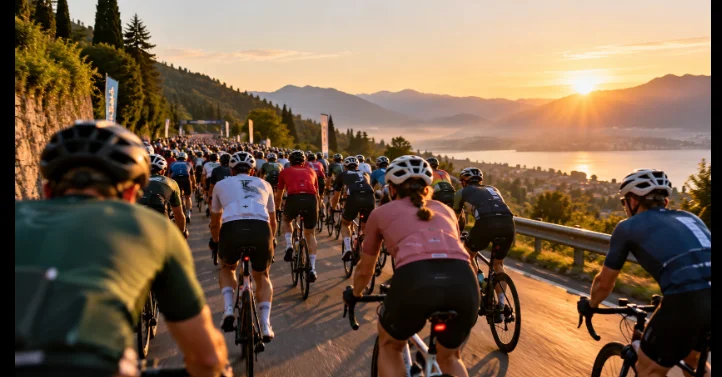
You might be perfectly comfortable riding 80 km alone, yet feel uneasy when your first gran fondo begins with several hundred cyclists rolling away together. The distance hasn’t changed, but the space available for braking, turning and making decisions suddenly has.
Good group riding isn’t about staying inches from someone else’s rear wheel or keeping up with the fastest riders. It’s about being predictable, communicating clearly and knowing when to give yourself more room. Those skills make a first fondo safer and considerably more enjoyable.
Why your first fondo feels different from a solo ride
On a solo ride, you choose your line through a corner, adjust your pace whenever you like and stop for a drink without considering the cyclist behind you. In a group, those ordinary decisions affect everyone nearby.
You’re also dealing with riders who have different abilities, equipment and expectations. Some are chasing a personal best. Others simply want to complete their first 100 km. A busy starting area puts them together before the event has naturally spread out.
More riders mean less room for sudden decisions
The opening kilometres often demand more concentration than the middle of the ride. Cyclists are finding their rhythm, adjusting to the road and negotiating corners while the group is still relatively compact.
A sudden swerve around a pothole that would be harmless on an empty road can force several riders behind you to react. Unexpected braking has a similar effect, particularly when everyone is still accelerating and settling into position.
Keep your head up and look beyond the wheel directly in front of you. Watch for changes in the group several riders ahead, where possible. Anticipating a slowdown gives you more time to respond smoothly.
Group skills become especially useful once the start corrals begin to move. Knowing the full sequence of your first gran fondo day makes it easier to prepare for the busy opening kilometres without feeling rushed.
Find the right group, not the fastest group
If the event assigns start corrals by expected finishing time, choose one based on your actual training pace, the course profile and planned stops. Don’t select a faster group simply because you hope the extra speed will rub off.
For example, suppose your recent longer rides average around 21 km/h on comparable terrain. Starting with riders expecting to maintain 30 km/h over a hilly course is unlikely to help. You’ll spend the opening kilometres working harder than planned and may have little left for the final climbs.
Some events use controlled starts, while others release riders in waves or designated corrals. The Valley GranFondo in British Columbia, for example, has used start corrals based on distance, expected finishing time and riding experience.
If you’re unsure, a more conservative starting position generally gives you room to settle in. Avoid stopping abruptly to reposition yourself once the group is moving.
The group-riding habits that matter most
Most gran fondo group riding etiquette comes down to three habits: maintain a predictable line, leave enough space to react and communicate before changing what you’re doing.
Hold a predictable line
Ride smoothly rather than constantly moving around the road. When approaching a minor obstacle, assess the available space and traffic before adjusting your line. Don’t make a sudden sideways movement into another rider’s path.
Keep both hands available for braking and steering when conditions become demanding. Avoid looking down at your GPS computer for extended periods, reaching for food in a crowded section or turning your head so far that the bike begins drifting sideways.
If you need to stop, signal early, check your surroundings and move safely out of the flow of cyclists before slowing to a halt.
Leave room and avoid overlapping wheels
Overlapping wheels means allowing your front wheel to sit partly alongside another rider’s rear wheel while following close behind. If that rider moves sideways unexpectedly, contact can cause you to lose control.
Keep your front wheel behind the rear wheel of the cyclist ahead rather than beside it. Maintain a gap that allows you to react to braking, surface changes and your own handling ability.
There’s no universal safe following distance for every group. The appropriate gap depends on speed, visibility, weather and experience. In rain, on descents or when riding with unfamiliar people, give yourself considerably more space.
Experienced cyclists may ride close together to reduce wind resistance, but that doesn’t mean beginners should immediately imitate them.
Communicate before you move
Hand signals and short verbal warnings help riders understand what’s happening ahead. Learn the standard road signals first, then become familiar with the informal calls commonly used on club rides.
- Left turn: Extend your left arm horizontally.
- Right turn: Extend your right arm horizontally, or raise your left forearm upward with the elbow bent at a right angle.
- Slowing or stopping: Extend your left arm downward as prescribed by British Columbia’s Motor Vehicle Act.
- Road hazard: When safe, point towards the pothole, debris or obstruction and use a clear verbal warning.
- Passing: A calm call such as “On your left” alerts another cyclist to your approach.
- Group slowing: Calls such as “Slowing” or “Stopping” help communicate changes that may not be obvious farther back.
Informal cycling signals are not always identical between clubs. Ask the ride leader what the group uses before departure.
A signal should never compromise control of the bicycle. If conditions make it unsafe to remove a hand from the bars, concentrate on maintaining control and communicating verbally where possible. Riders behind you still need time and space to react.
What to do in six common situations
Knowing the rules is useful. Knowing what to do when a situation unfolds unexpectedly is more useful. These six scenarios cover decisions a first-time fondo rider may encounter.
| Situation | What not to do | Safer response |
|---|---|---|
| The group suddenly slows | Grab the brakes abruptly or swerve around another rider. | Look ahead, reduce speed progressively where possible and maintain your line and a safe gap. |
| You want to pass another rider | Squeeze through a narrow gap or pass without checking behind. | Check traffic and nearby cyclists, communicate and pass only when there is adequate space. |
| A feed station is approaching | Cut across riders to reach the entrance at the last moment. | Decide early whether to stop, signal and move towards the designated entry safely. |
| The road becomes narrow | Continue riding alongside others or force an overtake. | Allow the group to form a safe single-file line and wait for suitable passing space. |
| You enter a wet descent | Follow closely or make sudden braking and steering inputs. | Increase your gap, reduce speed before corners and descend within your handling limits. |
| You lose contact with your group | Sprint repeatedly to catch up, ignoring your planned effort. | Settle into a sustainable pace and allow a suitable group to form naturally if conditions permit. |
The group slows suddenly
Imagine approaching a junction where the riders near the front begin braking. If you’re watching only the rear tyre ahead, you may notice the slowdown too late.
Look farther up the road whenever sightlines allow. Ease off your pedals early and apply the brakes smoothly, using appropriate front and rear braking technique. Avoid steering into an occupied space simply to escape the slowdown.
If you can communicate the change without compromising control, warn riders behind you. Never assume that everyone has already seen the junction.
You need to pass or leave the group
RBC GranFondo Whistler’s event guidelines instruct riders to pass on the left and communicate before overtaking. That’s a useful model for a supported ride, although you must always follow the rules of your particular event and the applicable road conditions.
Before passing, look behind and check for vehicles or faster cyclists. Make sure there is enough clear space to complete the manoeuvre without forcing another rider to brake or change direction.
If you’re leaving a group because the pace is uncomfortable, don’t suddenly stop pedalling in the middle of a tight formation. Allow space to open, move to a safe position and gradually return to your own pace.
There’s no obligation to stay with a group that makes you uncomfortable.
You approach a descent, junction or feed station
These locations deserve advance planning because other riders may make different decisions from yours.
Before a descent, increase your following distance and choose a speed that leaves room for unexpected changes. Don’t treat the descent as an opportunity to recover time lost on a climb.
At a junction, follow traffic controls and event marshals. Never assume the road is closed to vehicles simply because you’re participating in an organised event.
At a feed station, decide whether to stop before reaching the entrance. Move towards the designated stopping area only when safe. Once you’ve collected supplies, rejoin the route carefully rather than accelerating straight into moving cyclists.
Road rules and event rules are not interchangeable
A gran fondo is an organised cycling event, but participation doesn’t automatically exempt riders from provincial traffic laws. Road closures, traffic controls and event-specific arrangements vary. The organiser’s instructions should explain how the route operates.
What British Columbia requires on public roads
British Columbia’s Motor Vehicle Act gives cyclists many of the same rights and duties as vehicle drivers, alongside specific cycling requirements.
On public roads, relevant requirements include:
- Wearing an approved bicycle helmet, unless a legal exemption applies.
- Obeying traffic signs, signals and applicable right-of-way rules.
- Riding as near to the right side of the roadway as practicable, subject to the law’s provisions and actual road conditions.
- Not riding two abreast on the roadway, except when passing.
- Using the prescribed hand signals when turning, slowing or stopping.
- Using the required front white light, rear red light and rear red reflector when riding between sunset and sunrise.
- Exercising due care and reasonable consideration for other road users.
These are British Columbia requirements, not a summary of cycling law across every Canadian province. Local bylaws and posted restrictions may impose additional conditions.
Single-file riding deserves particular attention. You may see recreational groups riding side by side, but familiar club habits do not override the provincial rules applicable on public roads.
What an event organiser may require in addition
Event organisers can impose participation and course rules beyond ordinary road requirements. RBC GranFondo Whistler, for example, prohibits riding in the aero position on aerobars and using headphones or cellphones while riding. It also requires participants to follow designated routes, respect marshals and give way to emergency vehicles.
Other events may have different requirements for start corrals, support vehicles, controlled sections, equipment or course cut-off times.
Read the current rider guide for your event rather than relying on instructions from another fondo. If a marshal tells riders to stop or the organiser announces a neutralised section, follow those directions even if the road appears clear.
Cycling BC’s Ride Leader Training programme reinforces the broader importance of route planning, communication, emergency procedures, road hazards and appropriate group formations. These are useful considerations for anyone preparing for an unfamiliar group ride.
Practise group riding before event day
You don’t need an entire season of club riding before your first fondo, but three well-chosen practice rides can expose problems that solo training won’t reveal.
Choose a beginner-friendly club or social ride with a clearly communicated pace. Tell the leader you’re new to group riding and ask whether regrouping and no-drop arrangements are offered. A no-drop ride generally aims to keep participants together, but the exact expectations should be confirmed.
Ride one — learn to follow without crowding
Start with a small, steady group on familiar roads. Your goal isn’t drafting efficiency. Practise holding a consistent line, looking beyond the cyclist ahead and adjusting to gradual changes in pace.
Maintain a comfortable following distance rather than copying the close spacing of experienced riders. Notice how much easier it is to anticipate braking when your attention extends farther up the road.
Afterwards, identify one situation where you felt rushed or uncertain. That’s what your next practice session should address.
Ride two — practise signals and safe passing
On the second outing, concentrate on communication. Practise calling out hazards, signalling changes and overtaking only where traffic and road width permit.
Ask the leader to explain unfamiliar hand signals before starting. Where practical, rehearse the movements in a quiet, controlled setting before using them among other cyclists.
You should also practise stopping and restarting without disrupting the group. Being able to pull over calmly is particularly useful for mechanical problems, clothing adjustments and feed stations.
Ride three — rehearse hills and regrouping
Choose a route with moderate climbs and descents similar to those you expect during the event. Southern Vancouver Island provides plenty of rolling terrain for this purpose, although roads and traffic conditions should determine the route.
Practise climbing at your own sustainable effort rather than matching every acceleration. On descents, allow extra space and avoid feeling pressured to follow a faster rider’s line or speed.
Discuss what happens when riders become separated. Some groups regroup at designated points; others continue at an agreed pace. Understanding the arrangement beforehand removes the temptation to chase dangerously.
Paceline riding is a separate skill. In a structured paceline, cyclists take turns leading while others benefit from drafting. It requires consistent pacing, precise communication and coordinated changes of position. A casual group ride may share the road and a common destination without using that formation at all.
For your first fondo, being able to ride predictably in a loose group is far more valuable than learning aggressive rotations or riding extremely close to another wheel. Formal paceline training can come later, with experienced instruction.
When riding alone is the better choice
Riding with others can reduce wind resistance and make a long event feel more sociable. It can also tempt you into a pace or level of risk that doesn’t suit your ability.
Consider leaving a group if the pace repeatedly pushes you beyond your planned effort, riders are braking unpredictably, overtaking feels unsafe or you’re uncomfortable with how closely everyone is riding.
You may also prefer to ride independently during technical descents, heavy rain or sections where group communication is poor. Give other cyclists room, remain aware of traffic and follow the designated course.
There’s no prize for staying attached to a group that makes the ride harder or less safe. A gran fondo is long enough for several different groups to come and go. Some will suit your pace; others won’t.
The most useful skill to bring to the start line is sound judgement. Hold your line, give people room, communicate clearly and choose your own sustainable effort. You’ll finish with something more valuable than a fast opening hour: the confidence to ride comfortably among other cyclists without letting the crowd make your decisions.