Do Strava Challenges Help or Hurt Your Cycling Training?

12 min read
Contents
- What Strava Challenges actually reward
- Distance, elevation and time-based challenges
- Badges, leaderboards and sponsored rewards
- When a challenge supports a real training goal
- Consistency when you’re building a routine
- A useful target for a long-ride block
- Community motivation without racing everyone
- When the app starts making training decisions for you
- Chasing monthly distance at the expense of recovery
- Turning easy rides into leaderboard attempts
- The wrong challenge at the wrong time
- Not every digital reward measures progress
- Achievement, social comparison and chance
- Which challenges make sense during a 12-week fondo build?
- Five questions to ask before joining another challenge
- 1. Does it support the ride you’re preparing for?
- 2. Can you complete it without losing recovery time?
- 3. Would you still do the ride without the badge?
- Let the training plan lead and the app follow
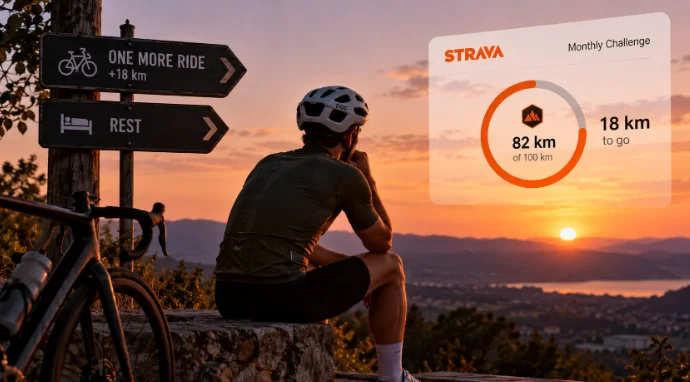
It’s Sunday evening, your training plan says rest, and Strava tells you you’re 18 km short of completing a monthly cycling challenge. An extra ride would earn the badge. Skipping it would leave your planned recovery intact. Which matters more?
Strava Challenges can make cycling more engaging, especially when you’re building consistency or preparing for your first gran fondo. But a digital target doesn’t know how tired your legs are, what you trained yesterday or whether you’re supposed to be tapering. The difference between useful motivation and unnecessary pressure often comes down to whose plan you’re following: yours or the app’s.
What Strava Challenges actually reward
Strava Challenges turn recorded physical activity into measurable objectives. Depending on the challenge, completing a certain distance, accumulating elevation gain, reaching an activity-time target or riding on a specified number of days can earn recognition within the platform.
Strava’s official documentation explains that challenges may run for a single day, several days or an entire month. Some involve individual targets, while others include group participation or competitive leaderboards. Each challenge has its own eligibility rules.
Distance, elevation and time-based challenges
A distance challenge rewards kilometres. An elevation challenge tracks climbing. A time-based challenge focuses on recorded activity duration rather than speed or distance. Other formats may recognise completing particular segments or being active on a certain number of days.
These distinctions matter for cyclists because the same numerical achievement can represent very different training demands.
For example, riding 200 km across several relatively flat routes isn’t equivalent to completing 200 km with substantial climbing. Neither necessarily tells you how well you’re preparing for a 100 km fondo. Terrain, intensity, recovery and the distribution of rides all affect what those kilometres mean.
Time-based goals may be more adaptable for beginners. An easy hour on a hilly route contributes to an activity-time target without requiring the rider to chase a particular speed. Still, even a time goal becomes counterproductive if it encourages riding when recovery is needed.
Badges, leaderboards and sponsored rewards
Completing an eligible challenge may earn a digital badge displayed in your Strava Trophy Case. Some challenges also have leaderboards comparing participants by distance, elevation, time or other qualifying measures.
A badge and a leaderboard position represent different achievements. The badge may confirm that you reached a defined threshold. Your ranking depends partly on what other participants recorded, making it a less direct measure of personal improvement.
Some sponsored challenges offer additional prizes or partner rewards. Strava specifies that prize eligibility and redemption depend on the partner’s rules, including potential country restrictions. A cyclist in British Columbia may be able to complete a challenge without qualifying for its associated prize.
Read the Details and Eligibility section before joining. Completing the activity target doesn’t automatically guarantee a physical reward, and earning a badge doesn’t prove that your cycling fitness improved.
When a challenge supports a real training goal
The strongest use of Strava Challenges is to reinforce riding you already have a good reason to do. A suitable challenge adds a little motivation without significantly changing the volume, intensity or recovery structure of your training.
Consistency when you’re building a routine
Suppose you’re preparing for a metric century and your plan includes three manageable rides each week. A challenge encouraging regular activity may provide a useful reminder to maintain that routine.
Rather than increasing your workload, the digital goal recognises something you were already working towards: showing up consistently.
Research offers some support for this approach, although the effects should not be exaggerated. A 2024 systematic review published in eClinicalMedicine found that gamification features in health apps produced generally modest improvements in physical activity and selected health measures compared with non-gamified approaches. That evidence doesn’t establish that Strava badges specifically improve endurance cycling performance.
The practical distinction is simple: an activity challenge can encourage consistency, but consistency should include appropriate recovery rather than mean riding hard every day.
A useful target for a long-ride block
Distance and climbing challenges can also complement structured fondo preparation.
Imagine your upcoming training block already includes progressively longer weekend rides and a moderate amount of climbing. A monthly distance goal that fits naturally within those sessions may be satisfying to complete.
An elevation challenge could provide similar motivation if you’re preparing for a hilly event. Around Victoria, routes through the Saanich Peninsula and inland hills offer different combinations of distance and climbing. Choosing suitable terrain can help you practise steady climbing without turning every outing into a maximum-effort session.
The challenge should reflect the training block, though, not determine it. If meeting the target requires substantially exceeding your planned workload, it’s probably the wrong challenge for that month.
Community motivation without racing everyone
Social features can make endurance preparation less solitary. Comparing progress with friends, sharing completed rides or participating in a club activity may provide encouragement during weeks when motivation is low.
Strava also offers private Group Challenges. According to its documentation, these can include collective activity goals where participants contribute towards a shared target without an individual leaderboard. Access to creating and joining these features can depend on subscription eligibility.
That distinction is useful. A collective goal can encourage participation without making the fastest or highest-volume rider the standard everyone else feels obliged to match.
For newer cyclists, supportive group challenges may be more appropriate than open competitions dominated by people with substantially more training time.
When the app starts making training decisions for you
A challenge becomes a problem when completing it consistently takes priority over your planned sessions, recovery or riding conditions. The warning sign isn’t enthusiasm for a badge. It’s changing sensible training decisions to satisfy an arbitrary deadline.
Chasing monthly distance at the expense of recovery
Consider a cyclist whose plan calls for five hours of riding in a recovery week. With two days left in the month, their Strava challenge still requires another 70 km.
Completing that distance would substantially increase the intended workload. The badge might feel rewarding, but the extra riding could leave the cyclist more fatigued when the next training block begins.
Monthly targets reset according to the calendar, not your body’s adaptation or your event schedule. A challenge ending on Wednesday has no special training significance simply because the app displays a countdown.
Missing a badge is preferable to repeatedly sacrificing rest days.
Turning easy rides into leaderboard attempts
Strava segments and competitive rankings introduce another temptation: riding harder than intended.
An endurance session might be planned at an easy conversational effort. Then a familiar climb appears, and the desire for a personal record turns several minutes into a hard interval.
An occasional spontaneous effort isn’t automatically disastrous. The problem develops when easy sessions repeatedly become competitive. Fatigue accumulates, and the distinction between training and testing performance starts to disappear.
For riders using heart rate or power, planned intensity provides a useful reference. Those riding by feel can use the talk test. If the purpose is easy endurance, you should generally be able to speak comfortably during most of the session.
The wrong challenge at the wrong time
An elevation target may suit a climbing-focused training block but become poorly timed immediately before a fondo. Likewise, a daily activity streak may encourage unnecessary riding during a scheduled recovery period.
Vancouver Island’s seasonal conditions add a practical consideration. A distance target that feels straightforward during long summer evenings may require riding in darkness, persistent rain or strong winds during shorter autumn days.
Changing a planned easy ride into an exposed, poor-weather outing purely to preserve a streak is difficult to justify. Indoor riding may be a reasonable alternative when appropriate, but challenge eligibility for virtual activities should be checked rather than assumed.
Not every digital reward measures progress
Digital platforms use several kinds of incentives, and they shouldn’t all be treated as evidence of achievement. The useful distinction is between completing a meaningful task, comparing yourself with others and receiving a reward that may have little connection to performance.
Achievement, social comparison and chance
A completed cycling challenge is primarily an achievement-based reward. You meet a defined condition, such as accumulating a certain distance, and receive recognition. The badge verifies that the platform recorded the relevant activity; it doesn’t measure the quality of every training decision.
A leaderboard introduces social comparison. Your position reflects not only your own performance but also the activity of other participants. Moving down a ranking can happen even when your cycling fitness is improving.
Random prizes work differently. Eligibility may depend on participation or completing an activity, while the eventual reward depends on a selection process. The prize itself isn’t proof that one participant trained more effectively than another.
Digital rewards can look similar on a screen while representing very different things. A cycling badge confirms that a recorded activity met a defined goal, while a random prize offers no reliable evidence of improved fitness.
The contrast becomes clearer with wager-based entertainment such as an xrp casino, where money and uncertain outcomes are central to the activity rather than a record of physical progress.
A sponsored cycling challenge may have its own prize conditions, but that should remain separate from evaluating the training itself. For a rider preparing for a fondo, the useful question is still whether the activity builds fitness without undermining recovery.
That distinction also helps explain why accumulating trophies can become misleading. Ten completed badges aren’t necessarily more valuable than a consistent month of well-paced endurance riding with adequate rest.
Which challenges make sense during a 12-week fondo build?
A structured training plan typically moves through base, build, peak and taper phases. Each serves a different purpose, so a suitable digital target should change alongside the training.
A monthly climbing challenge may seem useful during the build phase, but preparing for your first gran fondo also involves group skills, equipment checks and getting comfortable with the event itself.
| Training phase | Challenge that may help | Challenge to approach carefully |
|---|---|---|
| Base | Consistent activity time or a modest monthly distance goal that fits existing rides | Aggressive distance leaderboards that encourage sudden increases in volume |
| Build | Realistic climbing or endurance goals aligned with planned training | Daily hard-effort streaks or repeated segment attempts |
| Peak | An event-specific goal achieved through scheduled long rides | Unplanned mileage or elevation competitions |
| Taper | Optional light participation without additional workload | Last-minute kilometre chasing to finish a badge |
Consider a rider preparing for a 100 km event over 12 weeks. During the base phase, a modest activity-time challenge may help establish a routine. In the build phase, a climbing target might align with planned hill sessions. During peak training, the scheduled long ride matters more than any additional distance goal.
Once the taper begins, recovery takes priority. If the app’s challenge would require extra kilometres, the sensible choice is to leave it incomplete.
These are examples of matching challenges to an existing plan, not prescribed training volumes. A beginner riding four hours weekly and an experienced cyclist riding ten hours shouldn’t use the same arbitrary monthly target simply because they see the same badge.
Five questions to ask before joining another challenge
Before selecting Join, give the challenge a quick reality check. Five questions can identify whether it supports your preparation or merely creates another obligation.
1. Does it support the ride you’re preparing for?
Match the goal to an actual training need. If you’re preparing for a hilly fondo, manageable climbing practice may be relevant. If you’re trying to establish regular riding, consistent activity can make more sense than an ambitious leaderboard.
2. Can you complete it without losing recovery time?
Estimate how much activity the challenge requires beyond your existing plan. If completion depends on skipping rest days or adding substantial unplanned mileage, reconsider joining.
3. Would you still do the ride without the badge?
This is often the most revealing question. If the ride fits your goals, circumstances and available energy, a badge can be a pleasant extra. If its only purpose is preserving a streak or completing an arbitrary target, the reward may be driving the wrong decision.
Two further checks deserve attention before committing:
- Am I comfortable with the visibility requirements? Strava distinguishes between private challenge progress and public leaderboards. Eligible activities set to Everyone can appear on public rankings, while activities visible only to Followers or Only You may still count towards certain challenge goals. Group and segment challenges have additional rules. Review activity visibility, map privacy and the particular challenge requirements before joining.
- Am I eligible for the reward? Sponsored challenge prizes can have geographical restrictions and partner-specific conditions. Being able to participate from Canada does not automatically mean you’re eligible to receive a prize. Check the rules before allowing a potential reward to influence your training.
Strava’s privacy settings also allow users to restrict activity visibility and hide selected portions of route maps. If your regular rides begin or end near home, review those settings independently of any challenge. Sharing additional location information isn’t necessary for every useful training goal.
Let the training plan lead and the app follow
Strava Challenges are most useful when they recognise behaviour that already supports your cycling goals. A badge can make a consistent month feel satisfying, a collective challenge can add a social element, and a realistic distance target can provide encouragement through a long training block.
Problems begin when those rewards become more important than the reasons you’re riding. Distance isn’t automatically fitness, a leaderboard position isn’t a complete performance assessment, and an uninterrupted streak isn’t evidence that your recovery is adequate.
Choose challenges that fit your planned workload, check their eligibility and privacy conditions, and give yourself permission to leave them unfinished. A well-managed week with fewer kilometres can be more productive than an impressive monthly total earned through unnecessary fatigue.
When you finally roll across the finish line of your gran fondo, the digital badges won’t be turning the pedals. Your preparation will. The app can make that preparation more enjoyable, but it works best when you remain the one making the training decisions.